

12 Best Youth Football Offenses for 2026: Schemes, Safety, & Strategy

Stepping up to coach youth football is a massive commitment. But as every volunteer coach knows, a few weeks into practice, every spectator in the stands suddenly becomes a playbook expert with an opinion on how your offense should run.
At FirstDown PlayBook, we cut through that noise. You know your roster’s talent better than anyone, so our job is to provide professional-grade schemes that help turn your players into a cohesive unit. Designed by former NFL coaches with decades of youth development experience, our playbooks prioritize fundamental sound execution, player safety, and adaptability.
Before diving into scheme design, every sound football coach must establish a solid foundation. Here is how to select, teach, and execute the top 12 youth football offenses for the 2026 season.
1. Prioritize Player Safety Through Sound Fundamentals
A successful youth football coach always puts player welfare first. Teaching proper blocking, tackling, and execution isn't just about winning games. It’s about establishing safe habits that protect young athletes. This means starting with drill work that reinforces the fundamentals required to play the game.
-
Safe Schemes Lead to Safe Play: When players understand their assignments and execute sound techniques, the risk of injury decreases significantly. Parents trust you with their children; honoring that responsibility means keeping safety at the forefront of every drill.
-
Building a Foundation for High School: Not every player will continue their football career at the prep level, but those who do need a solid grasp of basic football concepts. A sound system ensures they don't arrive in high school behind the curve.
- Proven Schemes Outperform Trends: Avoid flashy, dangerous internet trends that aren't tailored for young athletes. Stick to battle-tested offensive systems that teach real football skills and create positive experiences on the field.
2. Evaluate Your Roster Before Selecting a Scheme
Before choosing an offense, take a hard look at your personnel. Knowing what your players cannot do is just as important as knowing what they can do.
Start at the Quarterback Position
The quarterback is the focal point of any youth offense. In the NFL, QBs win with arm strength; in youth football, they win with their ability to command the offense. You need a leader who can secure the snap, execute handoffs cleanly, and manage the huddle. If your passer has physical limitations, tailor your playbook around an effective ground attack rather than forcing a heavy passing scheme.
Organize Your Line and Backfield Realistically
Sort your players by size, mobility, and physical ability. While standard practice places larger players on the offensive line and agile kids in the backfield, stay open-minded:
- Scrappy, smaller players can excel on the line with proper leverage in a three-point stance.
- If your rules allow it, powerful, larger players often make dominant downhill running backs.
The Top 12 Youth Football Formations for 2026
Once you understand your roster’s identity, pick one or two core formations to master. Avoid overloading young players with too many formations, schemes or concepts.
1. Double Wing Formation
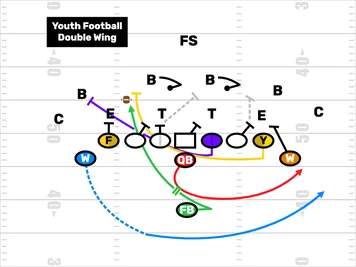
Best For: Fundamental development and balanced perimeter attacks.
The Double Wing checks every box for a youth coach focused on core blocking and tackling techniques.
- Balanced Defensive Keys: The balanced structure forces defenses to cover both flanks equally.
- Pre-Snap Versatility: Sending one of the wings in orbit motion instantly transitions the look into a two-back set, opening up option runs or inside misdirection plays.
- Forcing Cornerbacks to Tackle: By attacking the sidelines, your offense forces perimeter defenders into open-field tackle situations.
2. Power I Formation
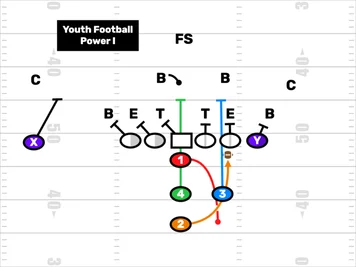 Best For: Downhill running and physical power football.
The classic Power I utilizes a two-fullback setup to create an aggressive, physical running game.
- Lead Blocking Flexibility: You choose which fullback serves as the primary lead blocker, or insert both to overwhelm defenders at the point of attack.
- Maximizing Backfield Talent: Ideal if you have 3–4 strong running backs on your roster who deserve playing time simultaneously.
- Misdirection and Bootlegs: In addition to downhill runs, the Power I naturally setups up counter plays and easy play-action bootlegs once linebackers over-commit to their fullback keys.
3. Wing T Formation
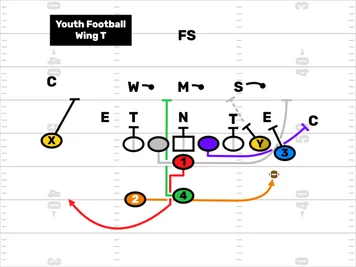 Best For: Discipline-based plays that force the defense to play assignment football.
The Wing T remains a staple across youth and high school levels because it forces defenders to play one assignment based on the scheme.
- The Core Dilemma: Forces defenders to respect both the inside fullback trap and the outside buck sweep on every snap.
- Linebacker Delay: Due to the fact that the core plays all look similar, Linebackers struggle with timely assignment execution.
- Weak side Counter Attack: When defenses cheat toward the wing side, simple weak side counters and quarterback keeps punish this strategy.
4. Spread Formation
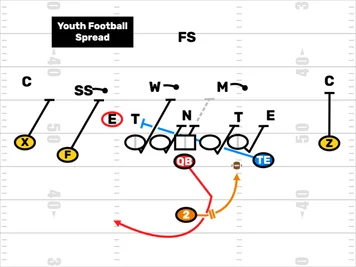 Best For: Teams with an advanced passer and quick decision-makers.
The Spread has dominated high-level football for years, but it requires specific personnel to work effectively at the youth level.
- Spacing the Field: Spreads defenders across the gridiron, creating wide lanes for both pass and run games.
- The Youth Quarterback Caveat: If your quarterback lacks the arm strength to penalize defenses for overloading the box, opposing coaches will ignore your wide receivers and stack the run defense.
- When to Run It: Ideal for 11U or 12U teams with skilled passers who can consistently execute short-to-intermediate throws.
5. Jumbo Formation
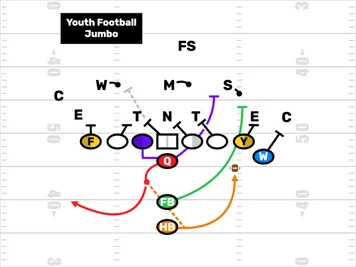 Best For: Heavy-set running with a strong perimeter attack.
Combining elements of the Wing T with a stacked backfield, the Jumbo formation delivers downhill power with an added wing-side edge.
- Gap Generation: Utilizing a heavy fullback who acts like an extra guard, creating unpredictable gap entry points for linebackers to process.
- Overcoming Fast-Flow Defenses: If defenders overplay the perimeter, a simple "G-Lead" counter play uses their momentum against them. This downhill attack fits well with the Wing based schemes.
6. Shoot Formation
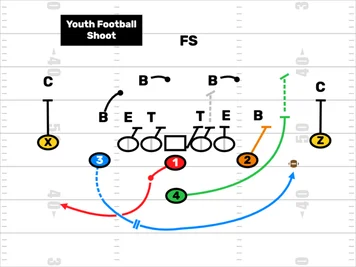 Best For: Speed option concepts and space creation.
The Shoot formation opens up the field while keeping dual-threat options on the table.
- Decoupling the Box: Widening the alignment may force defensive backs out of the box, opening running lanes for mobile quarterbacks.
- Orbit Motion Advantage: Motioning a slot back into the backfield pre-snap creates a rapid two-back look before the defense can adjust its strength keys.
- Precaution: Ensure your quarterback can complete standard outside throws so corners don't cheat their alignments inside to stop the run.
7. Wishbone Formation
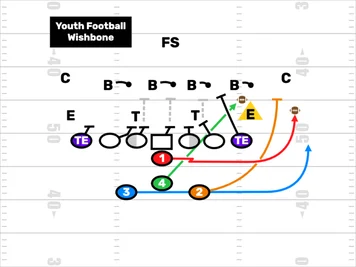 Best For: Option-style setups and multi-back versatility.
The Wishbone Formation is a timeless option-oriented scheme that forces defenses into disciplined, assignment-based football.
- True Pre-Snap Balance: A symmetrical backfield setup means you can run identical plays to either side without changing player alignments.
- Assignment Stress: Defenses must designate specific players to handle the dive back, the quarterback, and the pitch back on every play.
- Keep It Simple for Youth: You don't need complex mid-play option reads; call pre-determined dive, keep, or pitch plays off the same initial backfield look.
8. Split Backs Formation
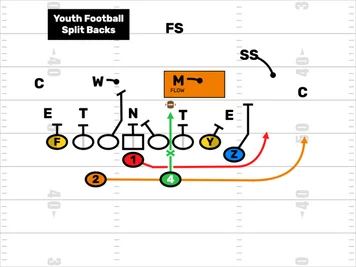 Best For: Deception, perimeter speed, and misdirection.
Split Backs allows you to maximize two running backs who excel in space but may lack traditional downhill blocking skills.
- Perimeter Attack: Great for running sweeps, tosses, and classic Split Back Veer concepts.
- Built-in Deception: Disguise simple dive plays to look like option reads, keeping linebackers frozen.
- Easy Bootleg Passing: Faking a full-flow run opens up clear play-action pass lanes to your tight ends moving in the opposite direction.
9. Trips Formation
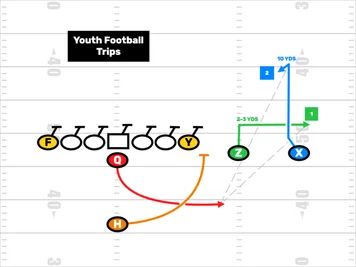 Best For: Overloading one side of the field with high-percentage passing.
By placing three eligible receivers to one side, the Trips formation forces defensive coordinators to make immediate tactical decisions.
- Numbers Advantage: If the defense fails to slide coverage to the formation strength, attack the three-receiver side immediately. If they over-adjust, attack the weak side.
- Helping the Quarterback Throw: Excellent for rolling or sprinting your quarterback toward the multi-receiver side, shortening throw distances and clarifying reads.
10. Pro I Formation
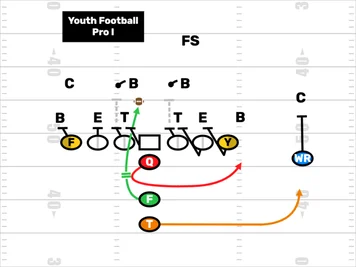 Best For: Balanced pro-style development and play-action setup.
The Pro I offers a classic mix of power running and structured two-man route options.
- Two-Way Attack: Features lead-block running behind a fullback alongside true perimeter options.
- Countering Linebacker Keys: Split your backs on the snap to throw off linebackers who key on the fullback's movement.
- Mastering Play-Action: Highly effective for teaching young quarterbacks play-action fakes, creating easy pass opportunities when defenders bite on the run.
11. Single Wing Formation
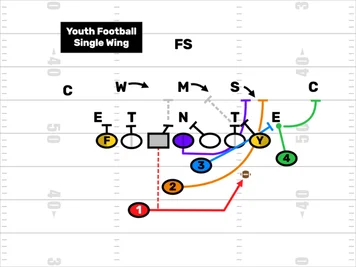 Best For: Unpredictable snap targets and power misdirection.
The Single Wing formation is a classic throwback system that remains extremely difficult for youth defenses to diagnose.
- Direct-Snap Confusion: The defense cannot reliably know who the ball handler will be because the snap can go to multiple backfield targets.
- Unbalanced Line Synergy: Pairs exceptionally well with unbalanced offensive lines, forcing linebackers into unfamiliar gap responsibilities.
12. 2 Back Slot Formation
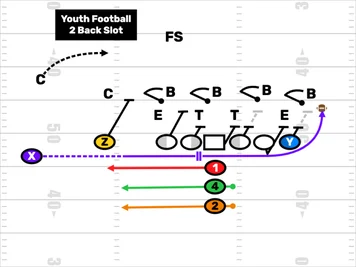 Best For: Pre-snap defensive coverage reads and versatile play-calling.
The 2 Back Slot formation helps a young quarterback diagnose the defense before the ball is even snapped.
- Revealing Coverage: Normally, defensive alignments will reveal whether they are playing man or zone based on how they match up against your two-receiver side.
- Targeting Matchups: If an opponent leaves a smaller cornerback on the weak side, run power concepts directly at that edge.
- Dual-Threat Capability: Retains a strong two-back run game while maintaining the passing flexibility of a spread setup.
Bonus Concept: Unbalanced Lines
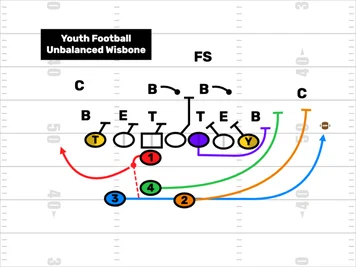 Running an unbalanced line by placing four linemen on one side of the center and two on the other is a high-leverage tool in youth football.
- Leverage Advantages: Overloads one side of the line, creating instant blocking numbers.
- Defensive Confusion: Defenses frequently misalign or leave eligible receivers completely uncovered against unbalanced fronts.
- Check your local league rules before installing unbalanced packages, as some youth organizations restrict them for fairness.
The Big Picture: Building Players for Life
Coaching youth football goes far beyond play-calling and formations. The impact you have on impressionable young athletes stays with them long after their playing days are over.
Focus on teaching discipline, hard work, and sportsmanship. Win or lose, the true metric of a great youth coach is building a positive environment where kids grow as players, and as people.
FirstDown PlayBook, a subsidiary of PlayBook Tech, is a comprehensive digital platform that provides modern coaching tools and resources for both tackle and flag football. With over 35,000 unique, editable plays, we empower coaches at every level, including youth, high school, and flag football coaches. Our mission is to simplify game preparation and elevate performance through innovative, virtual playbook solutions and player development tools. By combining technology with expert-driven content, FirstDown PlayBook helps coaches save time, develop players, teach smarter, and win more.